


Monitoring Large-Scale Battery Systems
Keyfacts Process/Application H2
Sector
[App]
Application
What is produced/tested
What are the measured values used for; how often is measured
Measured Parameter
Galvanic Isolation
Voltage DC/AC
Current
Speed signal Conditioning
High-Voltage Temperature
Key Requirements
[App] Measuring range
Special requirements: Operating environment (i.e. high temperature, shock, vibration), legal requirements, working voltage...

High Voltage Transducers with SIL Certification for Modern Storage Technologies
Photovoltaic installations and wind turbines are subject to weather-dependent fluctuations in energy production. This poses new challenges for supply grids worldwide.
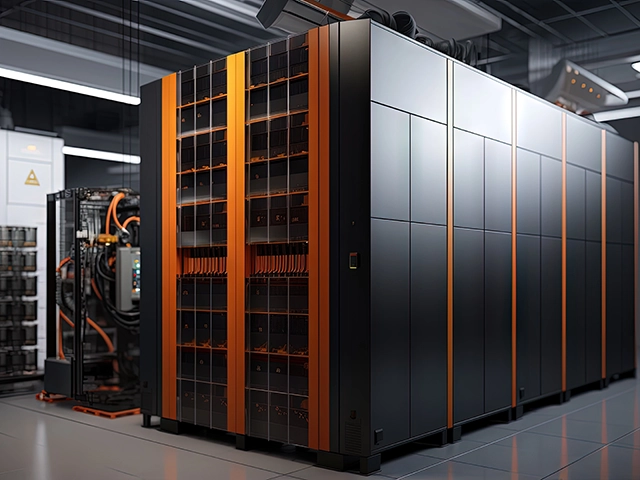
Large-scale battery systems offer an effective solution: They store surplus energy, release it as needed, and stabilize the power grid. The safety of these systems depends largely on the precise measurement of stack and string voltage—and can be further enhanced through the use of SIL-certified high voltage transducers.
Redox-Flow Batteries: The Storage Technology of the Future
Redox-flow batteries (RFBs) are ideally suited for storing surplus energy from renewable technologies. They are easy to scale, feature a long service life, and offer flexible capacity expansion. RFBs use two separate tanks filled with electrolyte solutions, which are pumped through galvanic cells.
Through reduction and oxidation processes, electrolyte potential differences of a few volts develop on the cell membrane. System operators interconnect hundreds of these cells into so-called stacks, which are then combined into strings. Based on this design, largescale battery systems achieve total voltages of up to 1,500 V DC.
Voltages and currents in the battery stacks and strings must be reliably measured for process control and monitoring. Measuring the open-circuit voltage UOCV at a single tapped cell also provides insights into the state of charge as well as aging and degradation processes.
Why Knick ?
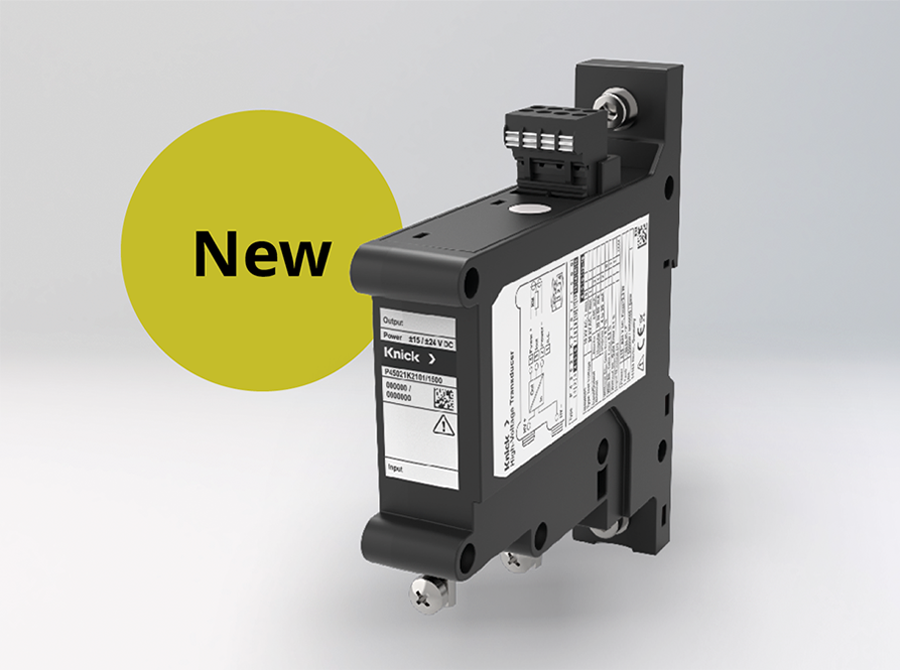
Precise measurement of nominal voltages of up to 3,000 V DC, combined with SIL 2 certification (or SIL 3 in redundant configurations) mean that the P45000 series high voltage transducers are ideally equipped for all future energy storage applications. In addition to reinforced insulation for up to 4,800 V DC, a common-mode interference of > 150 dB ensures error-free measurement and protects downstream control and evaluation systems. The signal conditioners are compact and support flexible mounting: horizontally, vertically, or on a 35 mm DIN rail. Moreover, multiple P45000 devices can be stacked as needed without difficulty.
Increased Safety with SIL-Certified High Voltage Transducers
Highly insulated signal conditioners of the P45000 series have proven themselves in safety-critical applications such as voltage monitoring of largescale battery systems, thanks to their certification in accordance with SIL 2 or SIL 3 in redundant configurations. Reinforced insulation for up to 4,800 V DC protects downstream control and evaluation systems from high potential differences. Unwanted disturbances such as electromagnetic interference are suppressed thanks to a common-mode rejection of > 150 dB. The result is accurate and reliable monitoring of the stack and string voltage.
Matching Products

Related Industries and Applications


Latest blog posts

Feb 2026
Interface Technology
SIL-compliant speed signal doubling for safety-critical applications

Nov 2025
Interface Technology
The Power Behind Data AI & Data Centers

Nov 2025
Interface Technology
High-Isolation Temperature Measurement at KEMA Labs
Sept 2025
Interface Technology
Functionally safe measurement of high voltages in industrial applications

Sept 2025
Interface Technology