


Current and Voltage Measurement in Synchronous Generators

Keyfacts Process/Application H2
Sector
[App]
Application
What is produced/tested
What are the measured values used for; how often is measured
Measured Parameter
Galvanic Isolation
Voltage DC/AC
Current
Speed signal Conditioning
High-Voltage Temperature
Key Requirements
[App] Measuring range
Special requirements: Operating environment (i.e. high temperature, shock, vibration), legal requirements, working voltage...

Precise Signal Transmissions in Excitation Systems
Thermal and hydroelectric power plants make a significant contribution to satiating the global appetite for energy. A key component of these systems is the synchronous generator, which ensures stability in our power grids. This is no easy task. After all, frequency and voltage fluctuations in the grid require dynamic excitation systems on the generator side that must react immediately to power changes. If this fails, there are considerable risks for operating a power plant—from serious damage to the generators up to complete plant failure.
High Demands on Today’s Excitation Systems
Excitation systems manage the most challenging tasks in synchronous machines, optimizing the generator performance while preventing damage or failure: They deliver direct currents of up to 10,000 A to the rotor windings of modern generators. Given such high currents, excitation systems require adequate isolation in accordance with IEEE 421. They also feature high control dynamics to be able to compensate for abrupt load changes by rapidly switching large consumers off or on. To ensure precise and responsive control of the synchronous machine, excitation systems also monitor all relevant variables, such as exciter currents and generator terminal voltages.
Why Knick ?
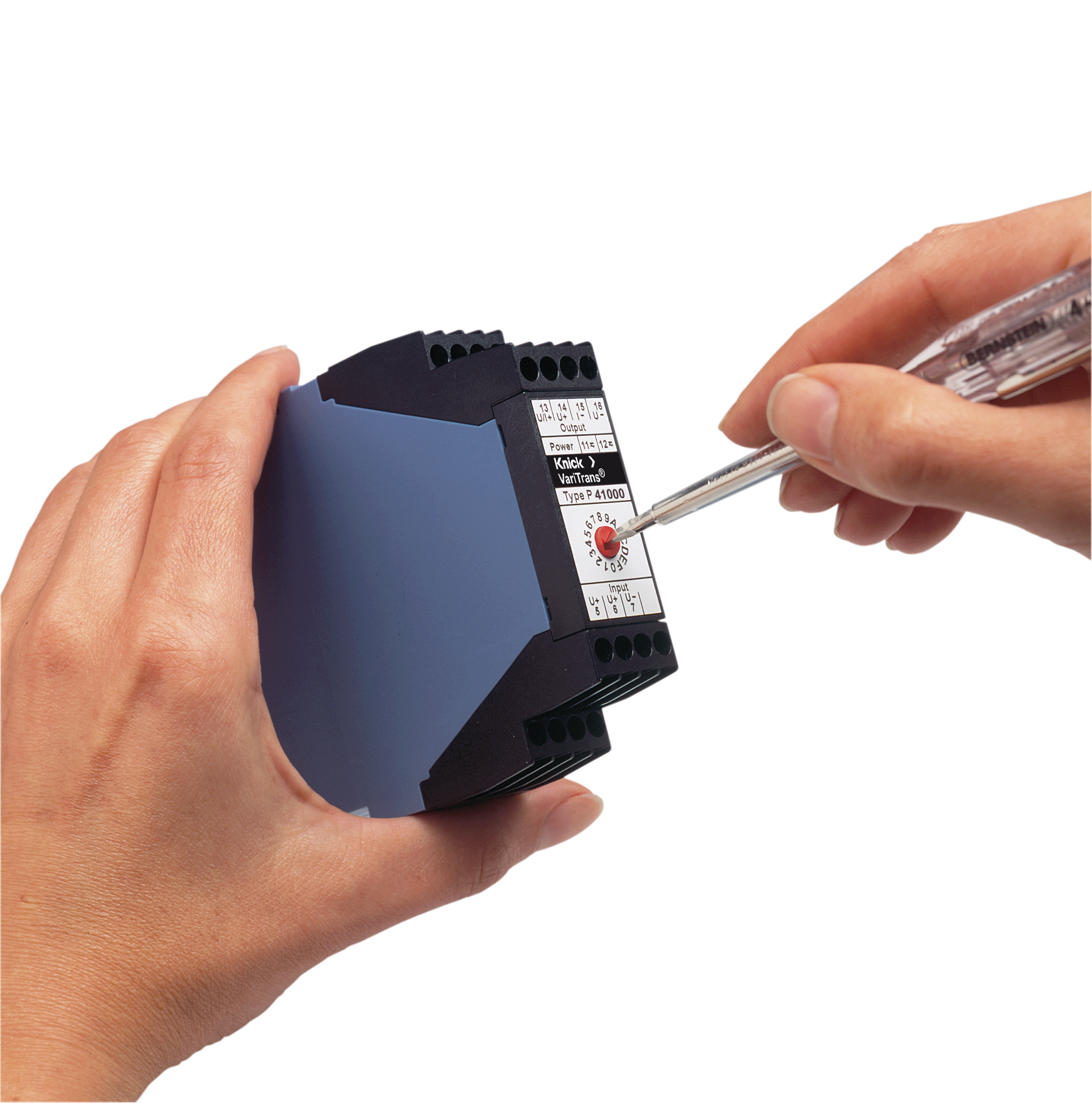
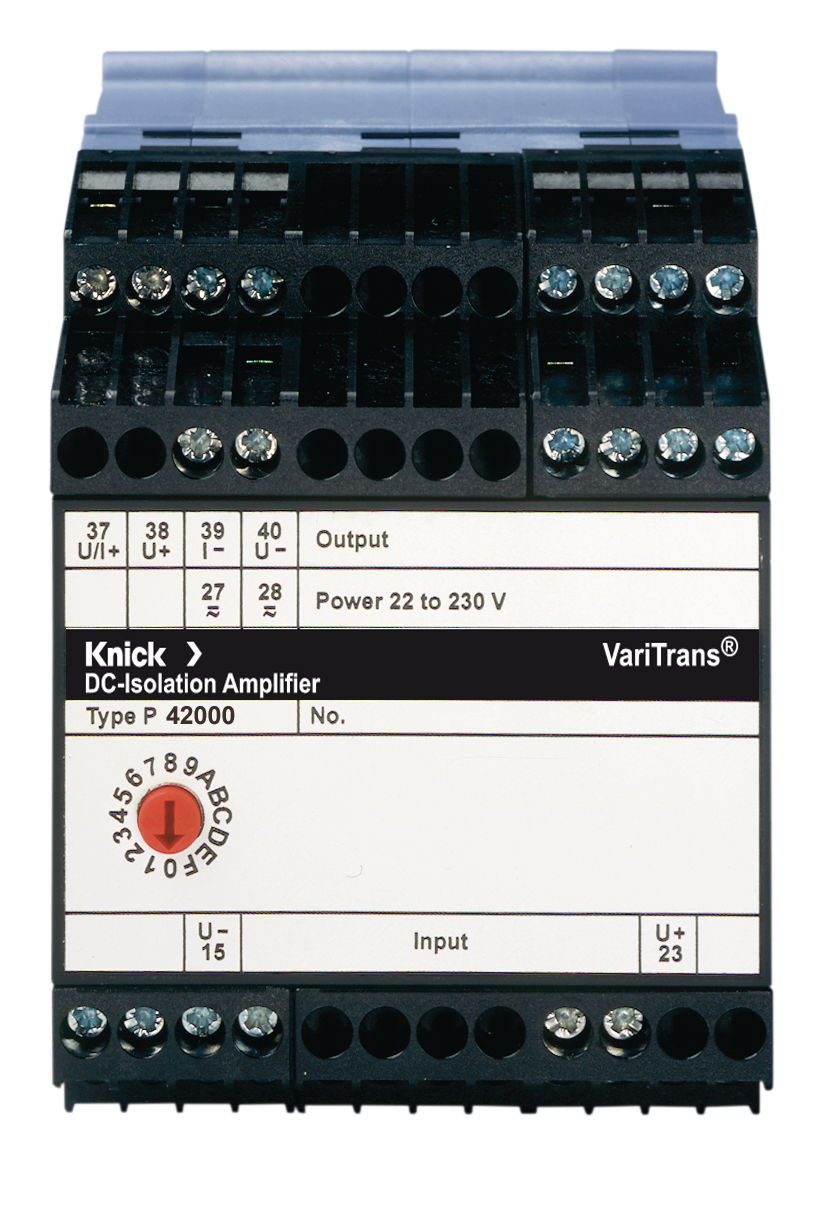
The high voltage transducers of the P40000 family have stood the test of time in current and voltage measurement. Their basic insulation withstands continuous voltages of up to 3,600 V DC, as well as transient overvoltages of up to 20,000 V. Additionally, precise measurements of currents up to 20,000 A are possible. The product family boasts an exceptionally long mean time between failures (MTBF) of 2,700 years, based on independently verified field data. Beyond these outstanding specifications, both the P41000 and P42000 are suitable for mounting on DIN rails—and are extremely space-saving thanks to widths of just 45 mm or 22.5 mm.
Solutions with Long-Term Stability for Uninterrupted Power Generation
Transducers in the P41000 series are ideal for monitoring exciter currents. Current measurement is performed via the voltage drop across the shunt resistor, whose cables are continuously checked for potential wire breaks. A gain error of < 0.1 % of the measured value and a T90 response time of < 110 μs ensure a precise and nearly instantaneous transmission of the outgoing standard signal. This enables the excitation field control to react quickly to possible load changes and optimally control the generator.
The generator terminal voltage is measured by P42000 series high voltage transducers. The signal conditioner determines the generator’s output voltage and then transmits a distortion-free standard signal to the control system—with a gain error of < 0.3 % and a T90 response time of < 110 μs. The excitation field control is therefore able to correct measurement errors by adjusting the voltage in the rotor windings, keeping the output voltage of the synchronous machine constant.
Matching Products
Related Industries and Applications

Latest blog post

Mar 2026
Interface Technology
The Shift to 800 V DC in AI Data Centers — and Why Precise Measurement Is Critical

Feb 2026
Interface Technology
SIL-compliant speed signal doubling for safety-critical applications

Nov 2025
Interface Technology
The Power Behind Data AI & Data Centers

Nov 2025
Interface Technology
High-Isolation Temperature Measurement at KEMA Labs
Sept 2025
Interface Technology