


Reliable Signal Conversion for Nuclear Control Room Testing

Key facts about the application
Sector
Nuclear Power
Application
PLC-driven Hardware-in-the-Loop (HIL) testing for interfacing new control equipment with legacy nuclear systems
Measured Parameter
4…20 mA simulated sensor signal converted to stable voltage outputs for downstream controllers
Main Requirements
Accurate and steady signal conversion, reliable isolation between PLC and legacy hardware, simple integration into test equipment

Precise signal conditioning and isolation for testing environment
Modernization projects in nuclear power plants require new control hardware to interface reliably with legacy systems that were never designed to communicate with today’s PLC architectures. Control system builders must validate these integrations through automated test equipment before deployment. In PLC-driven hardware-in-the-loop (HIL) setups, simulated sensor signals such as pressure and temperature are generated to replicate real operating conditions. Any instability or inaccuracy in signal conversion can compromise validation results and increase downtime in the deployment of the new equipment. Reliable, isolated signal conditioning becomes essential to ensure accurate testing and dependable performance in safety-critical nuclear environments.
Description and requirements
Nuclear control systems builders develop automated test equipment to validate new control modules before commissioning. This ensures compatibility with legacy systems and allows for testing of modern equipment to take place. For testing, a PLC receives simulation commands from a central server and generates analog outputs that replicate field sensor signals like reactor parameters. These outputs are transmitted as 4…20 mA signals, consistent with traditional process instrumentation.
To interface with downstream controllers, the current signal must be converted into a precise voltage signal. A resistor provides the load, while the signal conditioner ensures an accurate and stable voltage output. The challenge lies in maintaining signal integrity during continuous automated testing, where even minor drift or instability can skew validation results.
Additionally, electrical isolation is critical. The testing environment must prevent ground loops and signal interference between modern PLC hardware and legacy control inputs. Long-term reliability, component availability, and straightforward integration are equally important, particularly in nuclear projects where procurement delays and requalification can significantly impact project timelines or power production.
Why Knick ?
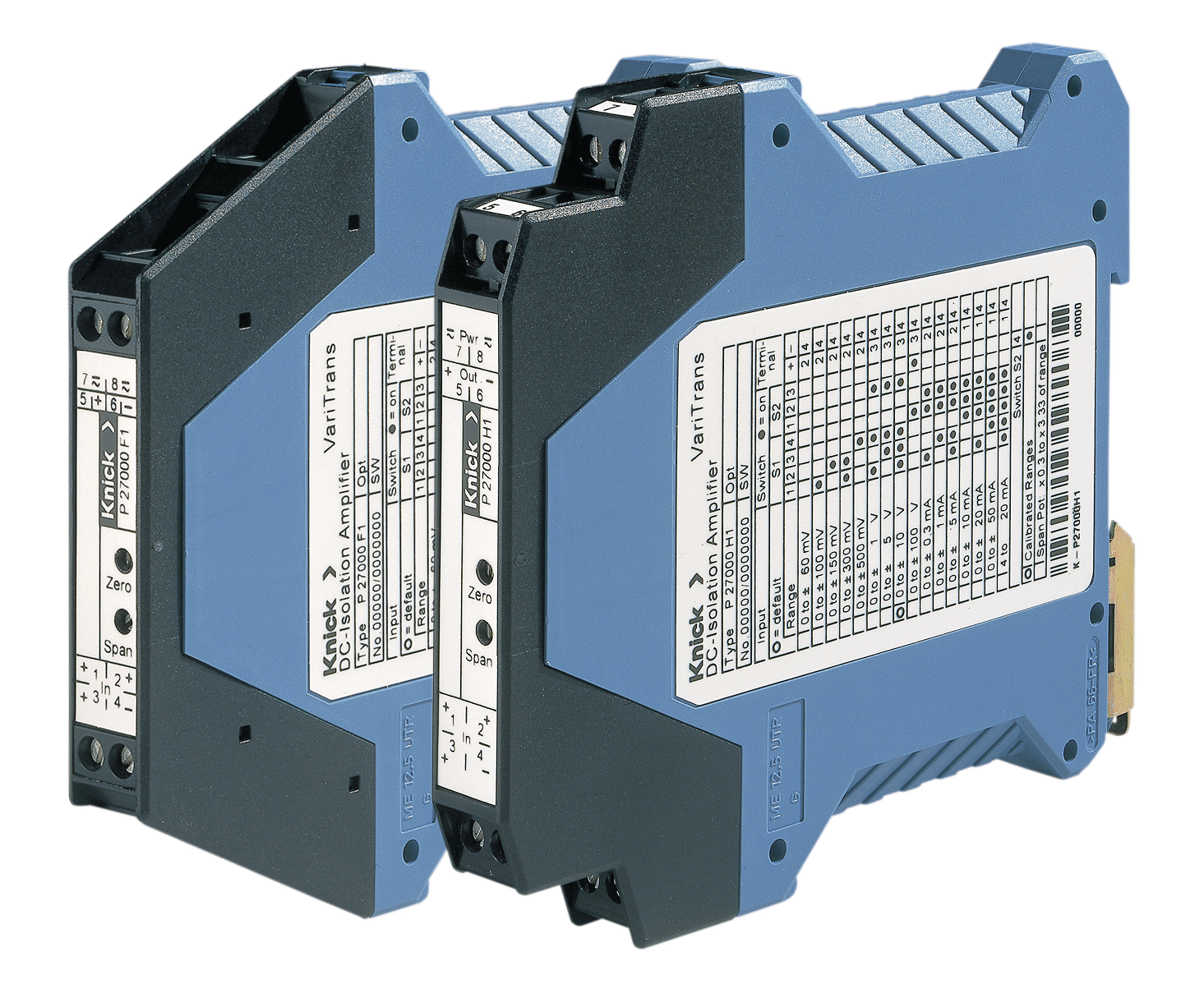
The P27000 signal conditioner meets the demands of high-accuracy, long-term testing environments, particularly in nuclear applications where integrating new control systems supports optimized plant performance and improved operational efficiency. With a broad array of input/output configurations, the device enables future expansion and additional use cases, offering more than 400 factory-calibrated ranges for flexible deployment. It provides precise mA-to-voltage conversion with a stable, drift-free output and reliable galvanic isolation between the PLC and downstream controller. The device also offers pure analog conversion, meeting strict safety requirements in the nuclear industry.
Conclusion
Durch die Integration des P27000 in automatisierte Prüfeinrichtungen wird eine stabile und reproduzierbare Signalschnittstelle zwischen modernen SPS-Architekturen und bestehenden nuklearen Steuerungen realisiert. Die präzise Milliampere-zu-Spannungsumwandlung gewährleistet eine zuverlässige Hardware-in-the-Loop-Validierung, die Risiken vor der Inbetriebnahme reduziert.
Neben der technischen Leistungsfähigkeit verkürzt die einfache Installation die Aufbauzeit der Prüfsysteme und vermeidet Verzögerungen in Modernisierungsprojekten. Das Ergebnis ist eine effiziente Prüfplattform, die die sichere Integration neuer Steuerungstechnologien unterstützt und gleichzeitig die hohen Zuverlässigkeitsanforderungen in Kernkraftwerken erfüllt.
Headline Crosseling Products H2


Headline Crosslinked Blog Posts H2

5月 2026
Interface Technology
Precision Measurement in Fusion Energy Systems

3月 2026
Interface Technology
The Shift to 800 V DC in AI Data Centers — and Why Precise Measurement Is Critical


11月 2025
Interface Technology
